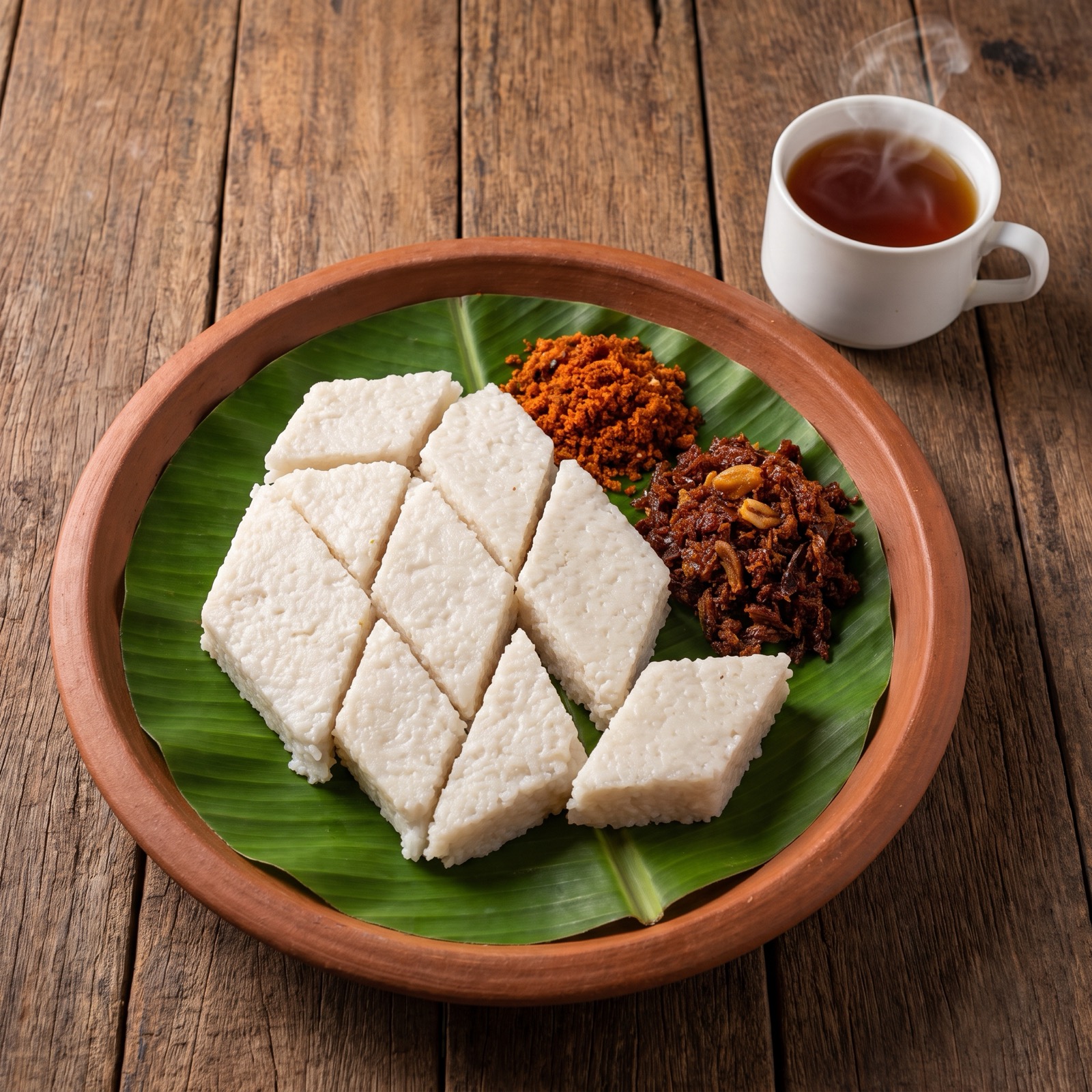
Kiribath — literally "milk rice" — is the most symbolic dish in Sri Lankan cooking. It's the first meal of the Sinhala and Tamil New Year, eaten on birthdays, at the start of a new month, and to mark any fresh start. Despite that weight of tradition, it's one of the simplest things you can make: rice cooked until soft, then finished with thick coconut milk until rich and creamy, and pressed into a flat cake to be cut into diamonds.
The classic pairing is lunu miris — a hot pounded sambol of red onion, chilli and Maldive fish — whose fire cuts through the mild, creamy rice. Some eat it sweet instead, with jaggery or banana. Use short- or medium-grain rice if you can; it turns creamier than long-grain basmati.
Ingredients
- 2 cups short- or medium-grain white rice (samba or sushi rice work well)
- 3 cups water
- 1 1/2 cups thick coconut milk
- 1 tsp salt
Method
- Rinse the rice in a few changes of water until it runs mostly clear, then drain.
- Put the rice and water in a heavy pot. Bring to a boil, then reduce to a low simmer, cover, and cook for about 15 minutes until the water is absorbed and the rice is soft. It should be a little wetter than usual — slightly overcooked is right here.
- Pour in the thick coconut milk and add the salt. Stir well to combine.
- Cook uncovered over low heat, stirring often so it doesn't catch, for 8–10 minutes, until the coconut milk is absorbed and the mixture is thick, glossy and creamy. It should hold together when you drag the spoon across the bottom.
- Tip the hot rice onto a clean flat tray or a banana leaf. Using the back of a greased spoon or damp hands, press and flatten it into an even slab about 2.5cm (1 inch) thick.
- Smooth the top and let it cool and set for 5–10 minutes.
- Cut into diamonds: make parallel diagonal cuts one way, then cross them the other way. Serve warm or at room temperature with lunu miris.
Cook's notes
- Use short- or medium-grain rice — it releases more starch and gives kiribath its signature creaminess.
- Add the coconut milk only after the rice is fully cooked, or the rice can stay hard.
- Wet your spoon or hands before pressing the slab so the sticky rice doesn't cling.
Good to know